Podlesie
The PeasantsPodlesie is the manor grange beside Lipce where debt, land hunger, and competing claims to settlement converge. First discussed as a possible source of farmland for crowded Lipce, it becomes the object of negotiations between The Squire, German buyers, and the villagers; later, its fields are divided among peasants, and a new household and windmill take shape there. The place is not merely a distant estate: its changing ownership and use bring the village’s hopes for land into direct contact with the power to sell, the need to survive, and the question of who belongs.
Setting and position
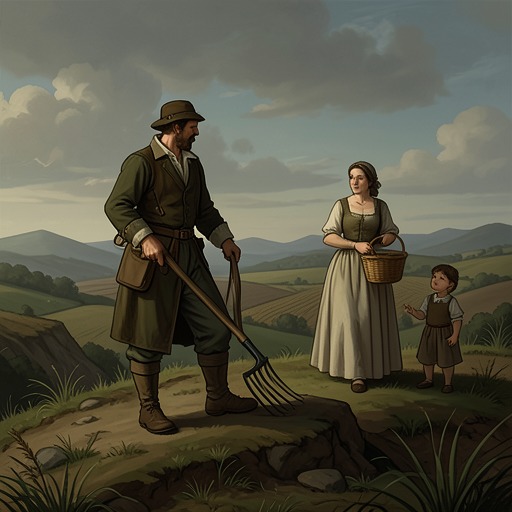
Podlesie lies beside Lipce’s fields, near the manor lands that extend beyond the village mill toward the forest. Its position makes the grange appear close enough to offer a practical answer to Lipce’s shortage of land. In conversation, villagers imagine its acreage as sufficient for thirty farms, a possibility made urgent by the cramped conditions at home: Lipce’s people are described as choking for room while the estate holds fields that are nearly lying fallow. The contrast between crowded households and underused land gives Podlesie its first importance in village debate.
That prospect is complicated by the estate’s financial circumstances. Although The Squire is regarded as wealthy, villagers hear that he owes money, faces unpaid obligations, and has not paid manor workers their New Year’s payment in kind. The restriction on felling in the wood, pending agreement with the peasants, is also said to limit his options. These reports fuel speculation that he may be looking for a buyer. Podlesie thus enters the story not as an untouched reserve waiting to be settled, but as an asset caught between debt, land-use restrictions, and the competing interests of its owner and neighbors.
Proposed sale and German settlement
The possibility of a sale becomes concrete when people are seen measuring arable land at Podlesie, while yellow-painted wagons appear near the cross at the fork in the road by the burnt ricks. The signs prompt speculation that the grange is being bought. The German settlers of Podlesie have in fact nearly secured it: fifteen families are expected to establish a colony there. The proposed transfer arises from a debt of fifteen thousand roubles owed by The Squire to one of the Germans. Unable to repay it, he is willing to let Podlesie cover the debt and accept cash for the balance, but he delays while looking for another buyer because the German offer is only sixty roubles a morgen.
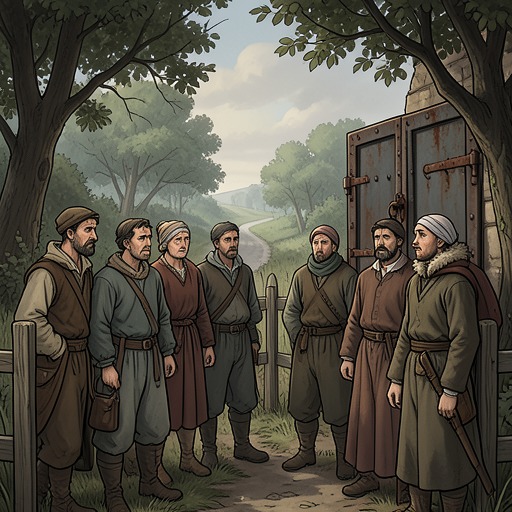
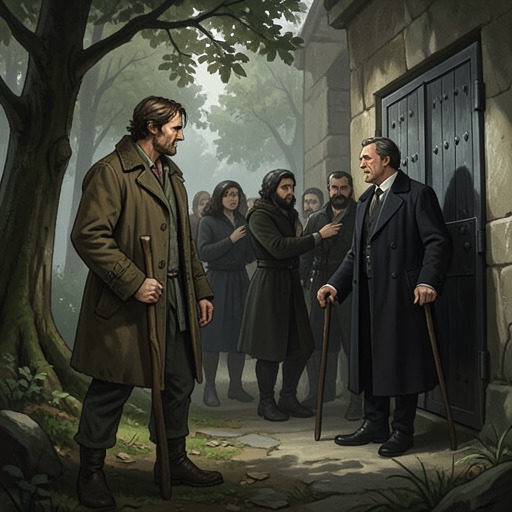
For Lipce, the prospect of German settlement is inseparable from the village’s own hunger for land. Residents point out that thirty farms could be made from the estate, so a transaction that would bring in outside families appears to close off a chance for local people. Their opposition is expressed directly to the prospective buyer: a representative speaking Polish on behalf of the whole village asks him not to purchase Podlesie. The appeal makes the villagers’ claim collective, even though the land is not theirs to sell. It also shows the limits of that claim: they must petition the buyer, while the decision remains bound up with The Squire’s debts and negotiations.
The Germans do settle at the grange, but their stay does not last. They are later seen leaving in roughly a dozen horse-drawn britchkas, carrying household goods beneath canvas, with women and children in the vehicles and men walking alongside. Their large dogs run with the departing group as the Lipce dogs bark and snap back at them. The visible passage through the village turns an economic arrangement into a face-to-face encounter between neighbors. Afterward, the report that the settlers had no luck at Podlesie and that their cows failed gives a practical explanation for their departure, without erasing the earlier conflict over who should have had access to the land.
From proposed bargain to divided holdings
After the German settlement, Podlesie again becomes the subject of a proposed arrangement between the villagers and The Squire. The plan, described and worked out in chalk on a table, would give each peasant four Podlesie fields in exchange for a morgen of wood, with the land released in instalments. The Squire is also said to be willing to provide wood on credit for cottages. The chalk marks matter: they turn an abstract promise into a visible scheme for dividing particular fields and assigning them to particular people. Its scale is presented as a new farm parcel for everyone in Lipce, and the proposal is said to be genuine and destined for formal settlement before a notary.
The agreement does not end the uncertainty around the estate. Later, villagers report that land is being measured out at Podlesie again, a recurrence that keeps the question of allocation in circulation. The story distinguishes the hope of a broad communal arrangement from individual acquisition. Szymek, for example, secures six morgs bought from The Squire. The land adjoins Lipce fields on one side and lies by the forest, but its appearance sharply contradicts the promise suggested by acreage alone. It is a wasteland of old clay-pit hollows, rubble, stones, briars, weeds, boggy ground, and scattered pines, alders, and junipers. Even The Squire advises against it; Szymek insists on taking it because it is cheap, at sixty roubles a morgen, and because The Squire promises help with wood and other things.
The transaction gives Szymek a plot, not an immediately ready-made farm. Its poor condition makes settlement an undertaking whose value depends on labor and assistance as well as purchase price. The contrast between the imagined fertile opportunity of Podlesie and Szymek’s stony, overgrown holding underscores how the distribution of land can offer independence while transferring the work of making it usable to the new owner. In this sense, the estate’s division is a beginning rather than a resolution: possession opens a future, but does not remove its material difficulties.
A new household and the meaning of Podlesie
Podlesie becomes the setting for a new household as Szymek and Nastusia establish themselves there. The place is associated with their independent home and with construction that extends beyond the first plot: Szymek’s man is building a windmill, and Mateusz goes to the forest with him to choose timber. The windmill is a tangible sign of work taking root at Podlesie. Where earlier the estate’s value was debated through debts, sale prices, and the number of farms it might yield, the building project shows resources being gathered for a specific local enterprise.
The shrine at Podlesie also serves as a meeting and departure point. People say goodbye there as a company moves away along the sunny road, and Mateusz later finds someone sitting by the shrine to rest. These brief references place ordinary movement and communal life within the changing estate landscape, alongside the more consequential acts of surveying, bargaining, and building. Podlesie is therefore both a parcel of contested property and a lived-in edge of the village, connected to the forest, fields, road, and local religious landmark.
Across these changes, the grange exposes the unequal distance between land as an asset and land as a means of survival. The Squire’s debt makes sale possible; the German purchase threatens to redirect the estate away from Lipce; village petition and negotiation press a collective claim; and Szymek’s purchase converts a poor tract into the basis for an independent holding. Podlesie’s narrative significance lies in that unsettled movement from ownership to access and from access to labor. The land does not simply pass from one proprietor to another: each proposed settlement asks who can make a home there, what burdens accompany possession, and whether the village’s need can alter decisions controlled by wealth and title.